Build a conspiracy theory from scratch.
The best way to learn to spot a conspiracy theory is to make one yourself.
Pick a real news story. On the next step you'll choose who's behind it and why. Then walk through the four moves real conspiracists use, with a debunk on every step.
- Hunt anomalies — turn coincidence into evidence of a secret plot.
- Fabricate connections — draw lines between unrelated dots until they look meaningful.
- Dismiss counter-evidence — if a fact disagrees, make the fact part of the cover-up.
- Discredit the critics — dismiss people who point out flaws in your theory.
Pick the event.
Choose whichever real-feeling headline your imagination will run wildest with. Don't overthink it.
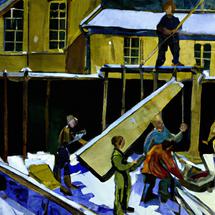
US campus unearths 142-year-old observatory
Workers installing hammock poles on Michigan State University's campus in August 2023 unexpectedly unearthed the buried stone foundation of an old observatory. Built in 1881 and demolished in the 1920s, the small structure had been covered over for decades. Archaeologists and university staff identified the masonry as part of that 19th-century building, making it a notable historical find on a modern college lawn.

Plants emit audible sounds when injured
Researchers led by Itzhak Khait at Tel Aviv University have found that some plants produce audible, high-frequency sounds when they are stressed or damaged. The team tested tomato and tobacco plants and recorded ultrasonic clicks that arise during drought stress or after cutting. Sensitive microphones and acoustic analysis allowed detection of these sounds from as far as five meters, suggesting plants may broadcast information about their physical condition.

Revive extinct creatures: big debate?
Scientists and conservationists are debating de-extinction, the idea of bringing extinct species back using modern genetic tools. Advances such as PCR, genome sequencing and gene editing have made it technically plausible to reconstruct genomes from preserved DNA. Companies like Colossal Biosciences aim to use these methods to create proxy woolly mammoths by editing Asiatic elephant DNA. Proponents argue such projects could help restore lost ecological functions and biodiversity.

The Dictionary People" Review: Word-Loving Nerds
Sarah Ogilvie’s The Dictionary People tells the story of the people who built the Oxford English Dictionary by collecting words, quotations, and regional usages. Ogilvie, a linguist, shows that the OED was not made by a single team in isolation but by thousands of volunteers who sent slips of paper and examples from newspapers, books, and everyday speech. The book explains how this wide network of contributors helped record English across time and place.